Industrial RO Plant – Reverse Osmosis Water Purification Solutions
Introduction
Water quality plays an important role in industrial operations. Many industries require purified water for manufacturing processes, equipment operation, cleaning, production, and product quality control. However, natural water sources often contain dissolved salts, minerals, microorganisms, and impurities that make water unsuitable for industrial use.
An Industrial RO Plant (Reverse Osmosis Plant) is an advanced water purification system designed to remove dissolved impurities and provide high-quality treated water for industrial applications.
Industries such as pharmaceuticals, food and beverages, chemicals, textiles, hospitals, laboratories, and manufacturing units depend on industrial RO systems for reliable water purification.
With increasing demand for water conservation and sustainable practices, modern RO plants can also be integrated with recycling and reuse systems to improve water recovery and reduce wastewater generation.
What is an Industrial RO Plant?
An Industrial RO Plant is a water treatment system that uses Reverse Osmosis technology to purify water by removing dissolved salts, contaminants, and impurities through a semipermeable membrane.
The RO process works by applying pressure to water and forcing it through a specialized membrane. The membrane allows water to pass through while rejecting a significant proportion of dissolved salts and other contaminants.
Commonly targeted contaminants include:
- Dissolved Salts
- Selected Heavy Metals
- Various Dissolved Chemicals
- Many Microorganisms, Depending on Membrane Integrity and System Design
- Selected Organic Contaminants
- Excess Minerals
The resulting purified water is suitable for industrial applications when its quality meets the specific requirements of the intended use.
Why Do Industries Need Industrial RO Plants?
Industrial processes require consistent water quality. Poor-quality water can affect product quality, equipment performance, manufacturing efficiency, and maintenance costs. An industrial RO plant helps industries achieve reliable water purification.
1. Removal of Dissolved Impurities
RO systems are designed to reduce various dissolved impurities, including:
- Total Dissolved Solids (TDS)
- Chlorides
- Sulphates
- Selected Heavy Metals
- Hardness-Causing Minerals
2. Improved Product Quality
Industries such as pharmaceuticals, food processing, and electronics require controlled water quality to maintain product consistency and meet process specifications.
3. Equipment Protection
Hard water and dissolved minerals can contribute to:
- Scaling
- Deposits on Equipment Surfaces
- Reduced Heat Transfer Efficiency
- Increased Maintenance Requirements
RO systems help reduce dissolved salts and minerals that can contribute to scaling, supporting more efficient industrial equipment operation.
4. Water Recycling and Conservation
Advanced RO systems can be integrated with wastewater treatment and recovery systems to recover suitable water for reuse, helping reduce freshwater consumption and improve overall water efficiency.
How Does an Industrial RO Plant Work?
An Industrial Reverse Osmosis Plant operates through multiple treatment stages to remove impurities and produce purified water according to the required quality specifications.
1. Pre-Treatment Process
Before water enters the RO membrane, pre-treatment removes particles and contaminants that may damage the membrane, cause fouling, or reduce system performance.
Sand Filter
A sand filter helps remove:
- Suspended Solids
- Dirt Particles
- Turbidity
Activated Carbon Filter
An activated carbon filter helps remove or reduce:
- Chlorine, Where Applicable
- Selected Organic Compounds
- Unpleasant Odour
Chlorine removal is particularly important when the selected RO membranes are sensitive to chlorine exposure.
Water Softener
A water softener uses ion exchange to reduce hardness-causing minerals such as:
- Calcium
- Magnesium
Proper pre-treatment helps reduce scaling and fouling risks, extending membrane service life when the system is correctly designed and maintained.
2. Cartridge Filtration
Cartridge filters provide additional filtration before water enters the RO system. They help capture fine particles that may remain after pre-treatment.
Cartridge filters help remove:
- Fine Particles
- Remaining Suspended Impurities
This filtration stage helps protect RO membranes from particle-related clogging and supports consistent system performance.
3. High-Pressure Pump
A high-pressure pump supplies the pressure required to push water through the RO membrane against the natural osmotic pressure.
The RO process separates the feedwater into two streams:
- Permeate Water: Water that passes through the membrane.
- Reject Water: Concentrated water containing rejected salts and impurities.
4. Reverse Osmosis Membrane Process
The RO membrane is the main purification component of an industrial RO plant. It separates water from a significant proportion of dissolved salts and other contaminants.
During this stage:
- Pressurized Water Enters the Membrane Assembly
- Water Passes Through the Semipermeable Membrane
- Many Dissolved Contaminants Are Rejected
- Purified Permeate and Concentrated Reject Streams Are Produced
Permeate Water
Permeate is the treated water collected after passing through the RO membrane. It can be used for industrial applications when it meets the required water quality specifications.
Reject Water
Reject water, also called concentrate or brine, contains a higher concentration of rejected dissolved salts and contaminants. It must be managed according to the wastewater characteristics and applicable disposal or recovery requirements.
5. Post-Treatment Process
Depending on the intended application, additional treatment may be required after reverse osmosis to achieve the desired water quality.
Post-treatment systems may include:
- UV Disinfection
- Ozone Treatment
- Electrodeionization (EDI)
- Mineral Adjustment or Remineralization, Where Required
- Additional Polishing Filtration
These processes help meet application-specific water quality requirements. The appropriate combination depends on the intended use and required purity.
Components of an Industrial RO Plant
A complete industrial RO system consists of several components that work together to provide reliable water purification.
1. Raw Water Tank
The raw water tank stores untreated water before purification and helps maintain a consistent supply to the treatment system.
2. Feed Pump
The feed pump transfers water from the storage tank into the pre-treatment and filtration stages.
3. Filtration System
The filtration system may include:
- Sand Filter
- Activated Carbon Filter
- Water Softener, Where Required
- Micron Cartridge Filter
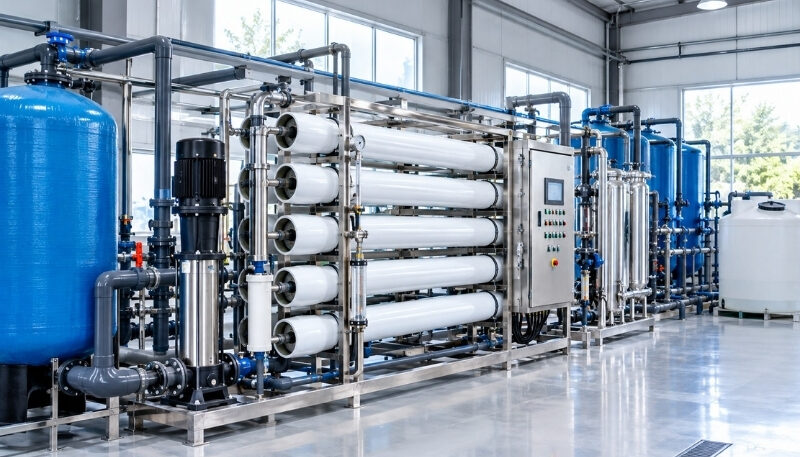
4. RO Membrane Housing
RO membrane housings contain the membranes responsible for separating water from dissolved salts and other rejected contaminants.
5. High-Pressure Pump
The high-pressure pump provides the pressure needed for the reverse osmosis process and helps maintain the required operating conditions.
6. Control Panel
The control panel manages plant operation through:
- System Automation
- Operating Parameter Monitoring
- Safety Controls
- Alarm and Shutdown Functions
7. Purified Water Storage Tank
The purified water storage tank collects treated water for subsequent industrial use or further treatment, depending on the application.
Types of Industrial RO Plants
Different industries require different RO system configurations depending on feedwater quality, production capacity, water purity requirements, and installation conditions.
1. Fully Automatic RO Plant
Fully automatic RO systems use automated controls to manage operating sequences, monitor system parameters, and perform selected functions with minimal manual intervention.
Key benefits include:
- Convenient Operation
- Reduced Routine Manual Intervention
- Consistent Process Monitoring
- Automated Safety and Control Functions
2. High-Capacity RO Plant
High-capacity RO plants are designed for industries that require large volumes of purified water for continuous or high-demand operations.
Common applications include:
- Manufacturing Plants
- Power Plants
- Large Industrial Facilities
3. Skid-Mounted RO Plant
Skid-mounted RO systems are pre-assembled units installed on a common structural frame to simplify transportation, installation, and commissioning.
Key advantages include:
- Faster Installation
- Compact Equipment Arrangement
- Convenient Transportation
- Simplified Equipment Integration
4. Containerized RO Plant
Containerized RO plants house water treatment equipment within a container or enclosure, making them suitable for projects that require a packaged or relocatable solution.
Common applications include:
- Remote Locations
- Temporary Water Treatment Requirements
- Large-Scale Projects
- Sites Requiring Packaged Treatment Equipment
Applications of Industrial RO Plants
1. Pharmaceutical Industry
Pharmaceutical companies require carefully controlled water quality for manufacturing, cleaning, and laboratory applications.
Industrial RO systems may be used for:
- Drug Manufacturing Water Pre-Treatment
- Equipment and Facility Cleaning
- Laboratory Applications
RO systems may be combined with EDI, UV treatment, ozone, and other purification stages to meet the specific water quality requirements of pharmaceutical processes.
2. Food and Beverage Industry
Food processing industries use industrial RO plants for applications such as:
- Ingredient Water
- Beverage Production
- Process Water
- Cleaning Applications
Consistent water quality helps maintain product quality and manufacturing process reliability.
3. Textile Industry
Textile manufacturing requires controlled water quality for:
- Dyeing
- Washing
- Fabric Processing
RO systems help reduce dissolved impurities that may affect dyeing consistency and fabric processing quality.
4. Hospitals and Healthcare Facilities
Hospitals and healthcare facilities may use RO systems for specialized water purification applications, including:
- Dialysis Water Systems
- Laboratory Applications
- Selected Equipment and Cleaning Processes
Applications such as dialysis require dedicated water treatment, disinfection, and monitoring systems that meet the relevant clinical and technical standards.
5. Chemical Industries
Chemical industries require controlled water quality for manufacturing, formulation, equipment cleaning, and process operations. Industrial RO plants can be configured according to the required water purity and the characteristics of the incoming water.
Benefits of Industrial RO Plants
1. High-Quality Water Purification
RO technology provides effective removal of many dissolved salts and impurities, helping industries achieve their specified water quality requirements.
2. Reduced Chemical Treatment Requirements
RO systems can reduce the need for certain chemical treatment processes. However, pre-treatment, membrane cleaning, and other chemical additions may still be required depending on the feedwater and system design.
3. Improved Equipment Efficiency
Reducing dissolved minerals can help limit scale formation in suitable applications and support efficient industrial equipment operation.
4. Water Recovery and Reuse
RO systems support water conservation by recovering treated water for suitable industrial applications. Recovery levels depend on water quality, system design, and operating conditions.
5. Customizable Solutions
Industrial RO plants can be designed according to:
- Raw Water Quality
- Purified Water Capacity Requirements
- Required Water Purity
- Industry-Specific Applications
- Installation and Automation Requirements
Factors Affecting Industrial RO Plant Cost
The cost of an industrial RO plant depends on raw water quality, required production capacity, selected technology, automation, installation conditions, and ongoing operating requirements.
1. Water Source Quality
Raw water characteristics determine the pre-treatment requirements and overall system configuration.
Important parameters include:
- Total Dissolved Solids (TDS)
- Water Hardness
- Suspended Solids
- Organic and Inorganic Contaminants
- Chlorine and Other Oxidizing Agents
2. Plant Capacity
Higher purified water demand generally requires larger membrane assemblies, pumps, storage tanks, and supporting treatment equipment.
3. RO Technology Selection
Project cost varies depending on the selected configuration, including:
- Single-Pass RO System
- Double-Pass RO System
- RO with Electrodeionization (EDI)
- RO with Additional Polishing Treatment
4. Automation Level
Fully automated systems may require a higher initial investment but can improve process control, monitoring, and operating consistency.
5. Installation Requirements
Civil work, piping, electrical systems, equipment foundations, commissioning, and maintenance access can affect the overall project cost.
Industrial RO Plant Maintenance Tips
Regular maintenance helps maintain RO plant performance, protect membranes, and extend equipment service life.
1. Regular Membrane Cleaning
RO membranes may require periodic cleaning to remove deposits, scaling, and fouling. Cleaning should follow the membrane manufacturer's recommendations and the actual operating conditions.
2. Filter Replacement
Pre-filters and cartridge filters should be inspected and replaced according to differential pressure, operating conditions, and manufacturer recommendations.
3. Water Quality Monitoring
Important parameters to monitor include:
- Total Dissolved Solids (TDS)
- pH
- Conductivity
- Feed and Permeate Flow Rates
- Operating Pressure and Differential Pressure
4. System Inspection
Regular inspection of pumps, valves, membrane housings, instruments, and control systems helps identify operational issues early and supports reliable plant performance.
Why Choose APK Aquatech for Industrial RO Plant Solutions?
Selecting the right industrial RO plant manufacturer is essential for achieving reliable water purification performance and efficient industrial water management.
APK Aquatech provides customized industrial RO solutions designed according to:
- Raw Water Quality
- Industrial Process Requirements
- Required Purification Standards
- Purified Water Production Capacity
- Installation and Automation Requirements
- Water Recovery and Reuse Objectives
With suitable engineering and water treatment technologies, APK Aquatech helps industries achieve reliable water purification, improve operational efficiency, and support sustainable water management through customized industrial RO plant solutions.